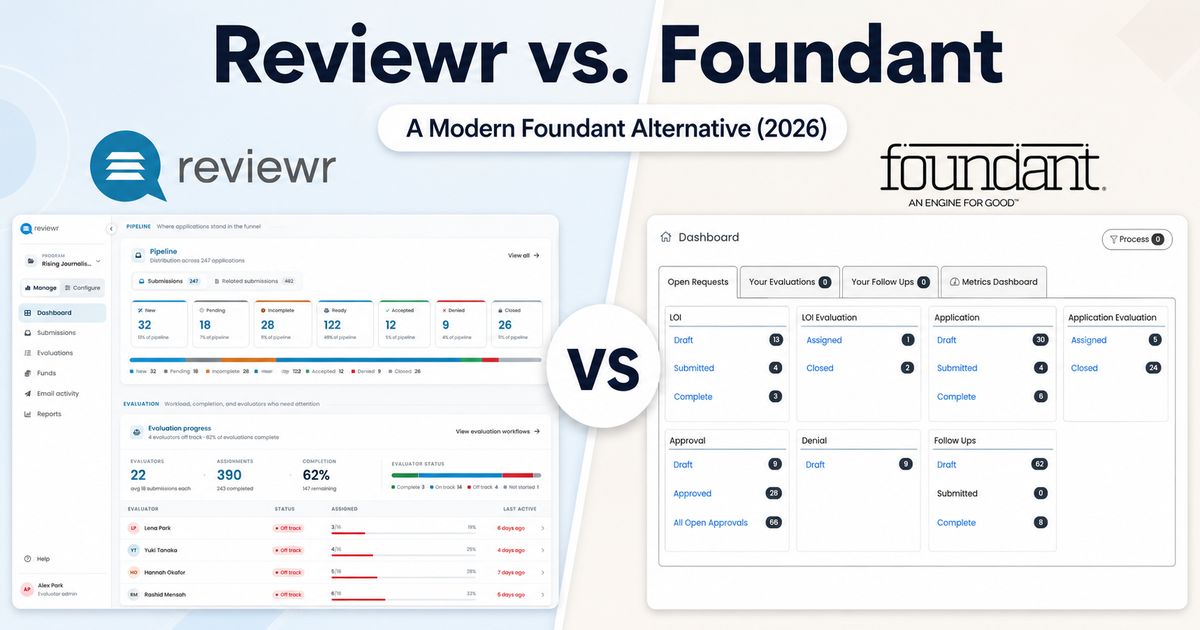
Reviewr vs. Foundant in one line: Foundant is an established, full-lifecycle suite for foundations — powerful but ecosystem-shaped — while Reviewr delivers modern program management on one platform without adopting a suite.
Foundant is the established suite for foundations — a powerful, full-lifecycle platform trusted by thousands of funders since 2007, spanning grants (GLM), scholarships (SLM), and fund accounting (CommunitySuite). For teams comparing Reviewr vs. Foundant, the question is usually whether you're buying an ecosystem or a modern platform for the programs themselves.
Foundant is genuinely capable, and this article won't pretend otherwise. But its history shows in the experience, and its deepest value assumes the whole suite. Reviewr delivers program depth in a modern platform — one clean experience, no suite required. Here's how they compare.
If you're short on time: Foundant is a capable platform, and this comparison names where it genuinely leads. But for most organizations running application-based programs, Reviewr is the stronger choice for these reasons:
For the full side-by-side breakdown, see our detailed Reviewr vs. Foundant comparison.
Foundant supports eligibility quizzes, references with a nice applicant-customized message, and a functional applicant flow. Reviewers describe it as simple to use — though the interface has aged over the years, and notification emails have been observed sending from a generic platform domain rather than your brand.
Reviewr delivers a modern experience end to end, with your program's brand carried through every page and every email. For programs that care how they present to applicants, that polish and deliverability matter.
A modern, branded experience — including emails that come from your domain — protects your program's reputation with applicants and improves deliverability. Small details like sender domain quietly shape applicant trust.
Where an established suite shows its age in the applicant experience, Reviewr delivers a modern, branded flow with emails from your own domain. Here's how Reviewr powers the applicant experience — and a few capabilities programs often don't realize they need until they have them:
Foundant's lifecycle depth is real — robust stage management, follow-up forms with automatic due dates, installment tracking — and its support and community are widely loved. Its pricing is often described as reasonable, with unlimited users included. Its deepest value, though, assumes the suite: grants in GLM, scholarships in SLM, and fund accounting in CommunitySuite, shaped around foundations.
Reviewr runs scholarships, grants, and awards on one platform, with the essential tools in every plan and no ecosystem to adopt. Setup is faster, and each program can be configured on its own terms rather than bent to one lifecycle shape.
The deciding factor is whether you want an ecosystem or a platform. Foundant's suite is compelling if you'll use all of it, especially fund accounting; Reviewr is simpler if you want modern software for the programs themselves.
Where Foundant's depth assumes the full suite, Reviewr delivers program depth on one platform without an ecosystem to adopt. Behind the scenes, Reviewr is built to reduce the administrative load that quietly consumes program teams:
Foundant offers side-by-side evaluation with everything a reviewer needs, plus data redaction — a solid, capable review experience, if not a visually modern one.
Reviewr matches that capability with a modern reviewer interface and adds normalized scoring and AI-assisted review. Reporting is a notable point of difference: where Foundant's own users describe building reports as where 'the confusion sets in,' Reviewr aims for board-ready outputs the first time, without a training course.
Reporting is a recurring pain point Foundant's own users name. If clear, board-ready reporting without a training course matters to you, that's a concrete, practical reason teams choose Reviewr.
Where Foundant's own users describe reporting as confusing to build, Reviewr aims for board-ready outputs the first time. Reviewr treats evaluation as the heart of the platform, with tools designed for fairness, speed, and decisions you can defend:
Foundant is strong after the decision, with stage-based follow-up forms, year-two forms, and installment tracking. And its CommunitySuite fund accounting is a genuine advantage for community foundations that want grants, scholarships, and fund accounting from one vendor.
Reviewr covers structured post-decision workflows — acceptances, deliverables, renewals, and recipient engagement — with SMS included, which Foundant's users have asked for. Choose Foundant if you want the full integrated suite, especially with fund accounting; choose Reviewr if you want a modern platform for the programs themselves. (Reviewr focuses on program management and post-award tracking, not fund accounting or disbursement.)
Foundant is strong after the decision, and its CommunitySuite fund accounting is a genuine draw for community foundations. Reviewr's advantage is a modern lifecycle experience with SMS included — a capability Foundant users have requested.
Foundant is strong after the decision and adds fund accounting; Reviewr matches the lifecycle depth and includes SMS its users have requested. Reviewr is built to carry a program past the decision — the stage where most tools hand the work back to you:
Yes — especially for organizations that want modern software for the programs themselves rather than a foundation-shaped suite. Foundant is powerful and well-supported; Reviewr offers a cleaner experience, clearer reporting, and scholarships, grants, and awards on one platform.
They're sibling products in the Foundant suite: Grant Lifecycle Manager for grants and Scholarship Lifecycle Manager for scholarships. Organizations running both typically license both. Reviewr runs scholarships, grants, and awards on a single platform.
Reviewr is purpose-built for application-based programs of every kind: scholarships, grants, awards, fellowships, competitions, and call-for-entry programs. It's used by foundations, nonprofits, associations, universities, K-12 schools, alumni associations, and corporations to collect applications, evaluate them, and select recipients on one platform.
Reviewr manages the full program lifecycle from application through evaluation and selection, plus post-award tracking such as acceptances, deliverables, and renewals. It does not disburse funds itself. If integrated payment or fund disbursement is a hard requirement, that's worth flagging early in your evaluation so you can weigh it against the depth Reviewr offers everywhere else.
Yes. Reviewr is SOC 2 Type II certified, meaning its security controls are independently audited on an annual basis — an important consideration for programs handling sensitive applicant data such as transcripts, financial information, and personal details.
Every program is different, and the honest answer depends on what you need. Foundant is a solid platform with real strengths. But if you want a modern, purpose-built experience for applicants, reviewers, and administrators — with the depth to run fair evaluations and the workflows to carry a program past the decision — Reviewr is built for exactly that. Reviewr is SOC 2 Type II certified, with 1M+ applications processed since 2011.
See the complete feature-by-feature comparison on our Reviewr vs. Foundant page.
Or schedule a demo.

The all-in-one platform for managing scholarships, grants and awards programs.