Modernizing Arts Grants & Impact Reporting with Reviewr
Overview
The Rozsa Foundation supports the arts sector in Calgary with multiple grant programs (e.g., Future Focus, Audience Development). As programs grew, staff needed a single, secure system to collect applications, collaborate with applicants and assessors, ensure fair review, and track long-term outcomes.
Rozsa adopted Reviewr to replace fragmented tools (email, spreadsheets, shared drives) with an integrated platform that streamlines application intake, review & selection, communication, and ongoing grantee impact reporting.
The Challenge
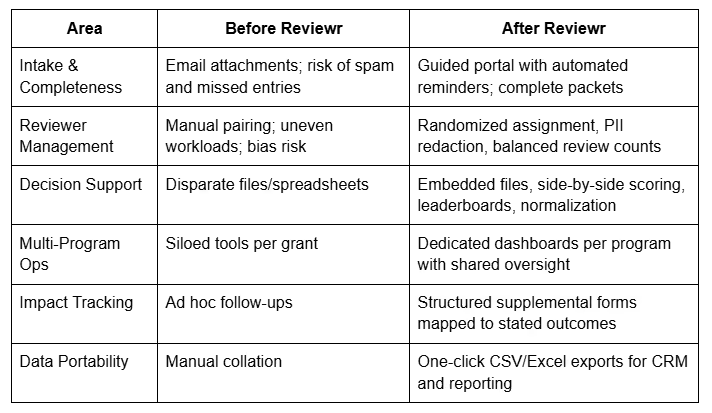
Lost & inconsistent intake: Email-based submissions and attachments risked spam filtering and version confusion; applicants repeated basic info across programs.
Reviewer fairness & logistics: Assessors often knew applicants, creating bias risk; last-minute cancellations left materials outside the Foundation’s control.
Operational overhead: Manual pairing of submissions to assessors, reminder chasing, and file handling consumed staff time.
Program sprawl: Multiple grants with distinct timelines required clear separation, yet centralized oversight.
Data governance: Need to protect applicant files, limit downloads where appropriate, and export structured data to Rozsa’s CRM.
The Solution: Reviewr Grant Management Platform
1) Low-Barrier, Complete Application Intake
Profile-centric portal lets organizations or individuals save & return, reuse core profile data across programs, and upload required files (budgets, work samples, docs).
Form builder collects project details, amount requested, alignment, success metrics—mirroring later reporting to ensure one-to-one continuity.
Automated nudges target “in-progress” applicants until completion.
2) Secure “Virtual Binder” Profiles
Every applicant receives a consolidated profile with embedded file viewers (video, audio, PDFs, spreadsheets) so staff and assessors review in one place—no downloads required.
Messaging inside the portal preserves an auditable communication trail and avoids email deliverability pitfalls.
3) Assessor Workflow Built for Fairness
Redaction of PII during review reduces community-relationship bias.
Randomized assignment engine balances workload and can enforce exactly N reviews per application (e.g., three).
Role-based controls allow “view but not download” where desired.
Leaderboards & score aggregation support decisions; ReviewIQ normalization identifies/corrects assessor scoring tendencies when not all assessors score all entries.
4) Multi-Program Structure with Simple Oversight
Each grant runs in its own dashboard (states, deadlines, buckets for phases like Intake → Phase 1 → Phase 2 → Selection → Reporting).
Staff maintain foundation-level visibility while keeping programs clearly separated for operations and auditing.
5) Ongoing Grantee Impact Reporting
Supplemental forms let grantees submit quarterly/annual reports directly to their profile (actual outcomes vs. stated outcomes, documentation, updates).
All deliverables are centralized for board reporting and year-over-year learning.
6) Data Control & Portability
Structured exports (forms, users, files metadata, results) to CSV/Excel for Rozsa’s historical CRM and internal analysis.
Optional restrictions on downloads for compliance; logs provide an audit trail.
Results
Key Outcomes
Higher completion rates and fewer intake errors
Less administrative time on assignments, reminders, and file wrangling
Fairer, more defensible selections through redaction and normalization
Clear year-over-year continuity from stated to actual outcomes
Easy exports to Rozsa’s CRM and stakeholder reports
The Impact
With Reviewr, the Rozsa Foundation now runs arts grants on a secure, efficient, and equitable platform. Applicants focus on content quality—not logistics. Assessors receive balanced, blinded packets. Staff coordinate multiple programs confidently, and impact data flows from application to reporting without redundancy. The result: more time for grantmaking and sector support, less time on administration.