Your scholarship program is probably running. Applications come in, reviewers score them, someone gets selected. But underneath that cycle, three common mistakes are quietly working against you — and most programs don't catch them until significant damage is done.
Running a scholarship program is no small thing. For most administrators, it's not even their primary job — it's something they've picked up alongside their regular responsibilities, driven by a genuine desire to invest in their community, their members, or their employees.
That dedication matters. But dedication alone doesn't protect a program from the three process gaps that quietly undermine even the most well-run scholarships — costing administrators time they don't have, burning out the volunteers who make selection possible, and leaving a program's real impact invisible to the donors and stakeholders who fund it.
We see these same three mistakes across scholarship programs of every size and type — individual scholarships, employee and family scholarships, community investment programs, and foundation-funded awards alike. And in every case, fixing them produces the same result: a program that runs more efficiently, produces better outcomes, and demonstrates its value clearly to everyone involved.
The hidden cost of "it works well enough": Even if your scholarship program appears cost-free — funded by donations, run by volunteers — the time invested by you and everyone involved carries real opportunity cost. If your program isn't growing, those hours are not being spent as effectively as they could be. That's a cost, even without an invoice.
One of the most common — and most avoidable — problems in scholarship administration is allowing ineligible applicants to move through your process unchecked.
Picture this: 300 people apply to your scholarship program, but only 150 of them actually meet your eligibility criteria. The other 150 spent time completing an application they were never going to receive. Your reviewers spent time evaluating submissions that should never have reached them. And you spent time — or someone did — manually sorting through the pool trying to identify who qualifies.
That's not a minor inconvenience. It's a structural inefficiency that compounds across every stage of your program, and it's one that most scholarship software simply doesn't address at the front door.
The flip side of the eligibility problem is equally costly: qualified applicants missing scholarships they don't know they're eligible for. When a program offers five, eight, or ten scholarships and applicants have to manually identify which ones apply to them, many will miss opportunities simply because the connection wasn't made explicit.
Opportunity matching changes that. Based on the answers applicants provide during intake, the system identifies every scholarship they qualify for and surfaces those matches automatically. The applicant doesn't have to guess. You don't have to wonder whether your best candidates are being considered for the right programs.
Ineligible submissions don't just waste time — they skew your scoring data. If you're running score normalization reports across your applicant pool and an ineligible submission is included, it can directly affect the relative scores of every other applicant. In a close competition, that could change who receives a scholarship.
Eligibility screening at the application level means setting defined criteria — GPA thresholds, enrollment status, geographic restrictions, employment requirements, financial need parameters, or any custom criteria your program requires — and allowing the system to enforce them automatically. Applicants who don't meet the criteria are stopped before they invest hours in a form they won't be considered for. Those who do meet the criteria move forward into a clean, pre-qualified pool.
❌ Without Eligibility Screening
✓ With Eligibility Checks & Opportunity Matching
One important design note: eligibility screening and opportunity matching can work as separate systems or run together. Some programs prefer to use matching logic first — surfacing the right opportunities — and then apply eligibility checks within each specific scholarship. Others run them together from the start. Either approach works, and the right choice depends on how your program is structured.
What matters is that the system does this work — not you, and not your reviewers.
.avif)
The most important moment in your entire scholarship program is the review. It's where your applicants' futures are being evaluated. It's where the integrity of your program either holds up or quietly falls apart. And it's almost entirely dependent on volunteers — people who have no obligation to stay, no salary motivating them, and no reason to return if the experience isn't worth their time.
That's a significant responsibility, and it's one that most scholarship programs are not adequately protecting.
The most common version of reviewer fatigue starts with unbalanced assignments. When nominations are distributed manually — without logic, without guardrails, without any way to verify fairness — some reviewers end up with 30 submissions while others have three. The reviewer with 30 is not going to produce the same quality of evaluation as the reviewer with three. They're rushing. They're fatigued. And they're probably not coming back next year.
Compound that with a fragmented review experience — having to open multiple tabs, download separate files, switch between a submission form and a scoring spreadsheet — and you've created a process that's genuinely unpleasant to complete. We hear this consistently from administrators whose reviewers have declined to return: it wasn't that they didn't care about the program. It was that the process made it too hard.
Even when reviewers are willing to push through a difficult process, scoring inconsistency can undermine everything they produce. This shows up in two ways.
The first is the absence of a rubric entirely — which happens more often than most programs want to admit. Reviewers are sent applications, told to evaluate them, and left to determine their own criteria. The result is a set of scores that reflect individual preferences as much as applicant merit.
The second problem is more subtle: even when a rubric exists, a numeric scale like 1–10 creates enormous subjectivity. What separates a 5 from a 6? One reviewer's 6 is another reviewer's 8. There's no shared standard, and in close competitions, that variance can determine who receives a scholarship and who doesn't.
Replace numeric scales with descriptive language. Scoring options like "exceeds expectations," "meets expectations," and "below average" create significantly less variance across reviewers than numeric scales. When you associate defined point values with those descriptors, you preserve quantitative scoring while removing the ambiguity that makes numeric scales unreliable.
The goal is a review process that's efficient enough to respect your reviewers' time, structured enough to produce consistent and defensible results, and transparent enough that both administrators and reviewers always know where things stand.

One additional feature worth highlighting is AI-assisted summarization. For programs running multi-round reviews or managing high application volumes, reviewers can access an AI-generated summary of each submission before diving in — giving them context quickly without requiring them to read every word before forming an initial impression.
.avif)
Selection day feels like the finish line. For most scholarship administrators, it's the moment all that work was building toward — the recipients are chosen, the announcements are made, and the cycle feels complete.
But it isn't. And the programs that treat selection as the end are quietly losing something far more valuable than they realize: the ability to prove their impact.
Think about your donors. They funded this scholarship. They attended the banquet, they heard the names announced, and that was probably the last substantive update they received. No thank you letter confirmation. No enrollment verification. No report on how the scholarship affected the recipient's academic trajectory six months later. Just silence — until next year's cycle begins and you ask them to contribute again.
That's not a sustainable relationship with your funders. And it's not a sustainable foundation for program growth.
Without impact data, you can't grow your program. More awareness, more proof, and more tangible outcomes bring in more donors, more applicants, and more community investment. If you're not tracking what happens after the award, you have nothing to show — and nothing to build on.
The administrative side of post-award management is equally difficult without the right infrastructure. Enrollment verifications, thank you letter confirmations, progress reports, transcript updates — each of these requires outreach, follow-up, and documentation. When it all lives across email threads and spreadsheets, some scholars slip through. Others simply don't respond. And administrators spend hours chasing information that should be flowing automatically.
Consider a common scenario: your scholarship is disbursed across two semesters, with the second disbursement contingent on proof of continued enrollment. Without a structured system, collecting that verification means manually emailing each recipient, waiting for replies, chasing the ones who don't respond, and trying to reconcile responses that arrive in different formats across different email accounts.
It's a process that's slow, inconsistent, and entirely dependent on your time and energy — when it should be automated, centralized, and largely self-managing.
❌ Without Post-Award Infrastructure
✓ With Reviewr Post-Award Management
The programs that grow are the ones that can prove their impact. When you can show a donor exactly how their scholarship affected a recipient's enrollment, GPA, career trajectory, or community involvement — with structured data and real narratives — you give them a reason to increase their contribution. You give prospective donors a reason to get involved. And you give your board or leadership team something concrete to point to when evaluating the program's value.

Impact reporting also closes the loop for your scholars. When recipients are asked to document how the scholarship supported them — and when that documentation is structured, easy to complete, and expected from the start — it reinforces the relationship between your organization and the people you're investing in. That relationship is part of what makes your program worth funding year after year.
Each of these mistakes compounds the others. Eligibility gaps mean reviewers are evaluating submissions that shouldn't be in the pool, which wastes their time and contributes to fatigue. Reviewer fatigue leads to inconsistent scoring, which undermines the quality and defensibility of your selections. And without a post-award system, the real outcomes of those selections go undocumented — leaving your program unable to demonstrate the impact that would attract more donors, more applicants, and more community investment.
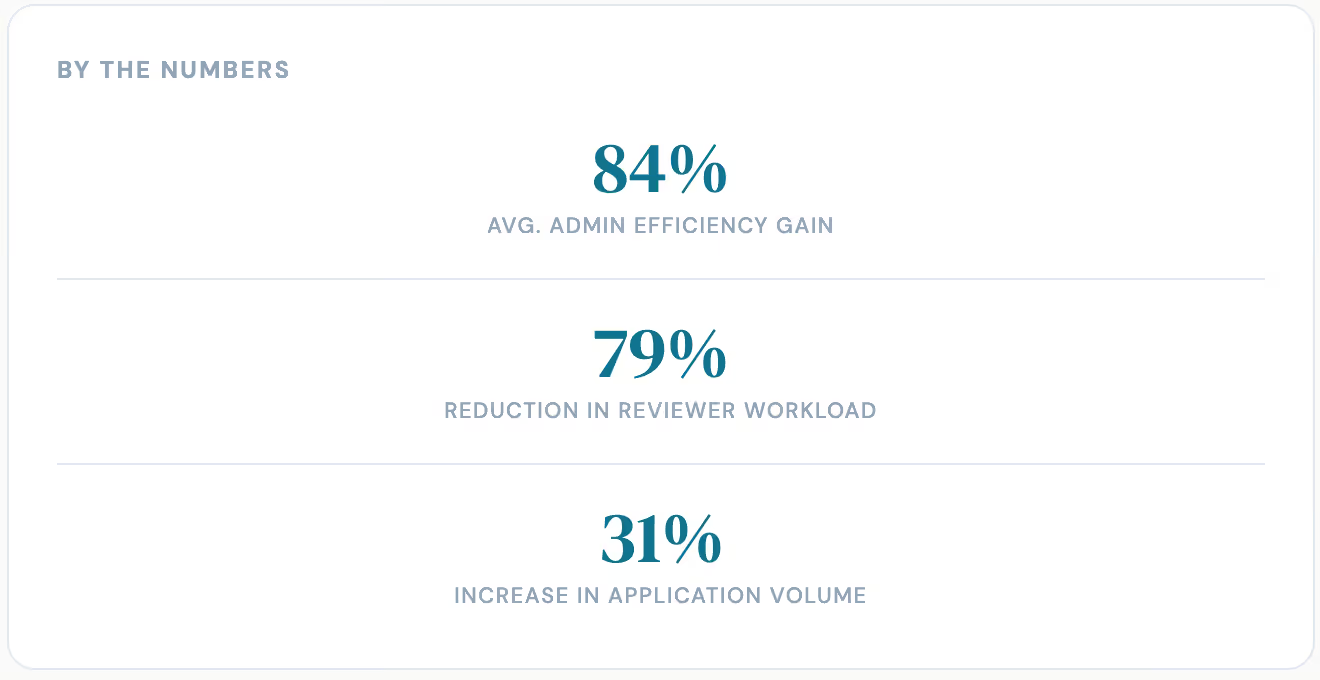
Fix all three, and the cycle reverses:
The programs running the most effective scholarships aren't necessarily the ones with the largest budgets. They're the ones that have built a process their applicants trust, their reviewers enjoy, and their donors can see the value of. That process is achievable — and it starts with addressing these three mistakes before your next cycle begins.
Reviewr is purpose-built for the organizations running scholarships — associations, foundations, nonprofits, higher education institutions, and corporate foundations alike. From eligibility screening and opportunity matching through structured review and post-award impact reporting, everything your scholarship program needs is in one place.
Schedule a 1-on-1 consultation with our team. We'll learn about your specific program, walk through your current process, and show you exactly how Reviewr can help — no pressure, just a real conversation about your scholarship program.

The all-in-one platform for managing scholarships, grants and awards programs.