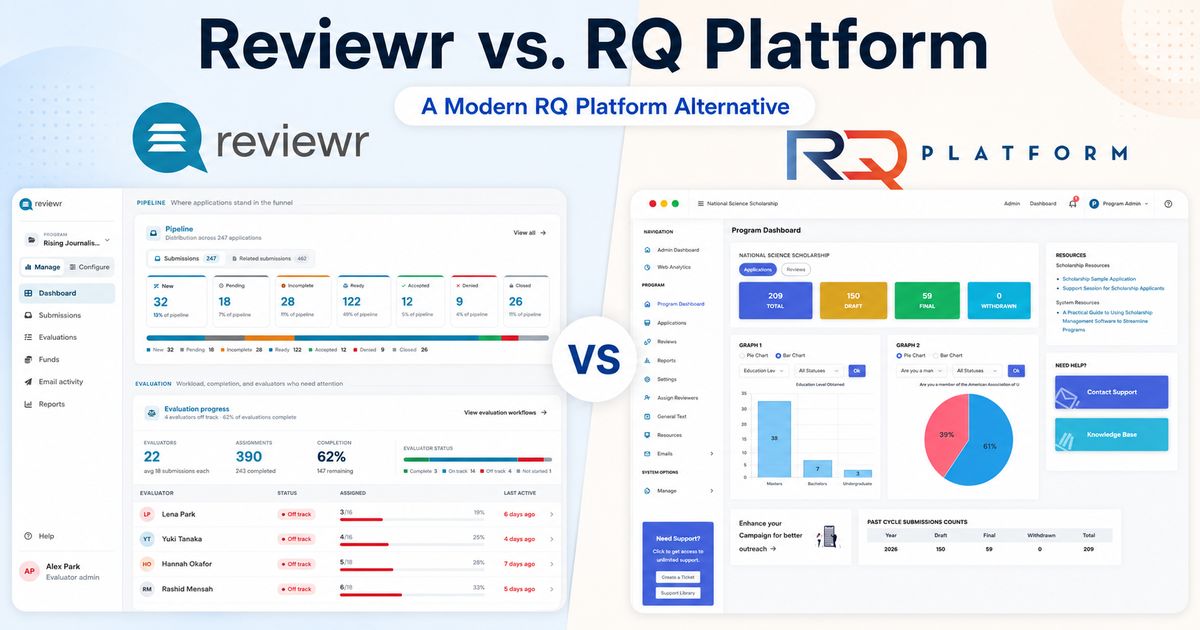
Reviewr vs. RQ Platform in one line: RQ Platform is an affordable, clean tool for simpler programs with strong support and mentorship features, while Reviewr is built for evaluation depth and serious, growing programs.
RQ Platform, from RhythmQ, is an affordable, clean application-management tool that serves simpler programs well and is known for excellent personal support. For teams comparing Reviewr vs. RQ Platform, the deciding factor is usually evaluation depth: RQ is built for simple programs, while Reviewr is built for serious ones.
Both platforms handle application collection with a modern feel. Where they separate is in how deep the review process goes and how much capability is available without moving up tiers. This article compares the two fairly, including where RQ genuinely shines.
If you're short on time: RQ Platform is a capable platform, and this comparison names where it genuinely leads. But for most organizations running application-based programs, Reviewr is the stronger choice for these reasons:
For the full side-by-side breakdown, see our detailed Reviewr vs. RQ Platform comparison.
RQ Platform offers a clean, modern applicant experience that reviewers consistently appreciate, with unlimited submissions across its plans.
Reviewr matches that modern feel and adds a profile-centric structure: everything an applicant submits assembles into one view for a coherent experience through review. Both are pleasant to apply through; Reviewr's edge shows up as programs grow more complex.
Both platforms feel modern to applicants, so this rarely decides the choice on its own — but Reviewr's profile-centric structure scales more gracefully as your applications get richer.
Where a tool built for simpler programs keeps things light, Reviewr's profile-centric structure scales as applications grow richer. Here's how Reviewr powers the applicant experience — and a few capabilities programs often don't realize they need until they have them:
RQ Platform is affordable and clean, with genuinely well-regarded personal support — a real strength for smaller teams. Some capabilities, like rule-based assignment, sit in higher tiers, and categories scale by plan.
Reviewr includes the essential operational tooling in every plan and adds cross-program visibility and richer configuration for teams running multiple or larger programs. The practical difference is how much you get without upgrading as your program scales.
The operational difference is how much you get before upgrading. Reviewr includes essential tooling in every plan; on RQ, some capabilities sit in higher tiers, so map your must-haves against each plan carefully.
Where some capabilities sit in RQ's higher tiers, Reviewr includes the essential operational tooling in every plan. Behind the scenes, Reviewr is built to reduce the administrative load that quietly consumes program teams:
RQ Platform supports review groups and works well for simpler evaluation needs.
Reviewr is built for evaluation rigor: coverage minimums, randomized distribution, panels, a judge queue, normalized scoring that surfaces reviewer bias, and AI-assisted review. For programs where fair, defensible outcomes matter — and where reviewer consistency is a concern — that depth is the core reason teams choose Reviewr.
This is the heart of the comparison. If your program needs coverage minimums, randomized assignment, normalized scoring, or AI-assisted review, Reviewr is built for that depth in a way a simpler tool isn't.
Where a simpler platform offers review groups, Reviewr is built for coverage minimums, normalization, and AI-assisted review. Reviewr treats evaluation as the heart of the platform, with tools designed for fairness, speed, and decisions you can defend:
RQ Platform offers genuinely strong options here: mentorship and alumni features, including mentor matching and an alumni directory, are a real differentiator for programs that want ongoing community.
Reviewr's post-decision strength is structured program lifecycle — acceptances, deliverables, renewals, and recipient engagement. Choose RQ if built-in mentorship and alumni community are central to your program; choose Reviewr if you want deeper evaluation and structured follow-through from decision into the award term. (Reviewr handles the lifecycle through decision and post-award tracking, not fund disbursement.)
The post-decision decision hinges on what 'follow-through' means to you. If it's mentorship and alumni community, RQ has purpose-built features; if it's structured deliverables and renewals, Reviewr's lifecycle tools are the better fit.
RQ offers strong mentorship and alumni features; Reviewr's post-award strength is structured deliverables, renewals, and reporting. Reviewr is built to carry a program past the decision — the stage where most tools hand the work back to you:
Yes — particularly for programs that need evaluation depth or expect to grow in complexity. RQ Platform is a strong, affordable choice for simpler programs and offers notable mentorship and alumni features; Reviewr is built for rigorous review and structured lifecycle management.
For larger or more complex programs, Reviewr's included evaluation depth — coverage thresholds, randomization, normalized scoring, and cross-program visibility — is designed to scale without moving up tiers. RQ Platform excels for simpler programs and community-focused features like mentor matching.
Reviewr is purpose-built for application-based programs of every kind: scholarships, grants, awards, fellowships, competitions, and call-for-entry programs. It's used by foundations, nonprofits, associations, universities, K-12 schools, alumni associations, and corporations to collect applications, evaluate them, and select recipients on one platform.
Reviewr manages the full program lifecycle from application through evaluation and selection, plus post-award tracking such as acceptances, deliverables, and renewals. It does not disburse funds itself. If integrated payment or fund disbursement is a hard requirement, that's worth flagging early in your evaluation so you can weigh it against the depth Reviewr offers everywhere else.
Yes. Reviewr is SOC 2 Type II certified, meaning its security controls are independently audited on an annual basis — an important consideration for programs handling sensitive applicant data such as transcripts, financial information, and personal details.
Every program is different, and the honest answer depends on what you need. RQ Platform is a solid platform with real strengths. But if you want a modern, purpose-built experience for applicants, reviewers, and administrators — with the depth to run fair evaluations and the workflows to carry a program past the decision — Reviewr is built for exactly that. Reviewr is SOC 2 Type II certified, with 1M+ applications processed since 2011.
See the complete feature-by-feature comparison on our Reviewr vs. RQ Platform page.
Or schedule a demo.

The all-in-one platform for managing scholarships, grants and awards programs.