
The American Neurological Association (ANA) presents the Wolfe Research Prize for Identifying New Causes or Novel Treatment of Neuropathy and Related Disorders — an annual award recognizing outstanding investigators whose work has significantly advanced understanding of pathogenesis or treatment of neuropathy and related neurological conditions. The award honors excellence regardless of institutional affiliation or career stage and includes an honorarium, complimentary meeting registration, travel support, and a commemorative plaque. Applicants are required to submit a nominee statement, CV, and supporting letters of nomination. The awardee presents findings at the ANA Annual Meeting.
Recognizing the need for a scalable, equitable, and efficient awards infrastructure that can support multiple concurrent campaigns and complex nomination workflows, ANA implemented Reviewr to power this award and its broader suite of honors.
As a prominent society in academic neurology and neuroscience, ANA’s awards portfolio — including the Wolfe Research Prize — required a platform capable of:
To meet these needs, ANA deployed Reviewr as a centralized platform for its award programs, including the Wolfe Research Prize.
1. Dual Nominator/Nominee Workflow
Reviewr’s flexible intake supports both self-nominations and third-party nominations. When a colleague nominates an investigator, Reviewr automatically notifies the nominee, guiding them to complete the same structured application form used for self-applicants. This ensures consistent information capture and equitable experience for all candidates.
2. Letter of Recommendation Module
Nominees enter the names and emails of their letter writers directly within the Reviewr application. Reviewr then triggers email invitations to those references, linking them to a secure reference portal where they can submit their letters. The platform tracks submission status in real time and sends automated reminders for outstanding references, reducing administrative follow-up and ensuring complete nomination packets.
3. Structured Document Uploads
Reviewr accommodates resumes/CVs, nominee statements, supporting documents, abstracts, and headshots within a single submission. Uploads are stored and displayed within the nominee’s profile, embedded for convenient judge access without external file tools.
4. Rubric-Driven, Fair Review Processes
Each award campaign in Reviewr is configured with its own scoring rubric and review committee. Judges access submissions securely, complete evaluations using numeric or qualitative criteria, and flag any questions or comments within the system. Reviewr’s scoring algorithms normalize results across judges to mitigate scoring discrepancies, ensuring fair and data-driven selection outcomes.
5. Multi-Award Infrastructure at Scale
Reviewr allows ANA to run multiple award programs concurrently — each with unique workflows, judges, eligibility checks, and deadlines — within one unified platform. Administrators maintain control over configuration, while judges and nominators experience a consistent interface.
6. Ongoing Impact Capture and Reporting
After awardee selection, Reviewr supports impact reporting workflows where recipients upload presentation materials, abstracts, or results of research related to their award. This ongoing data collection supports ANA’s reporting to stakeholders and provides continuity across annual cycles.
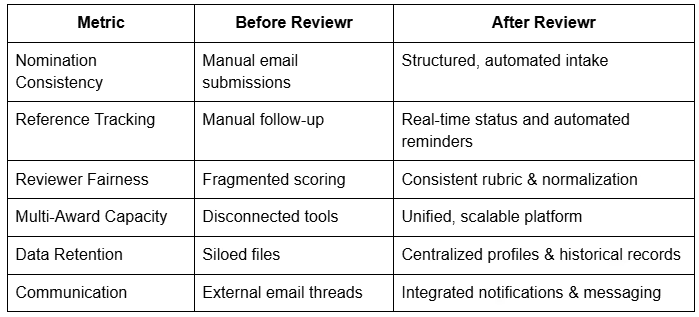
Through Reviewr, the American Neurological Association has transformed how it administers the Wolfe Research Prize and its suite of academic awards. The platform’s flexible nomination workflows, robust reference management tools, and scalable review infrastructure empower ANA to execute fair, transparent, and data-driven selection processes, while minimizing manual effort and supporting long-term impact tracking of awardees.
This modernized awards ecosystem enhances ANA’s ability to recognize significant scientific contributions in neuropathy research and beyond — fostering excellence in neurological science and reinforcing the prestige of its honors portfolio.

The all-in-one platform for managing scholarships, grants and awards programs.